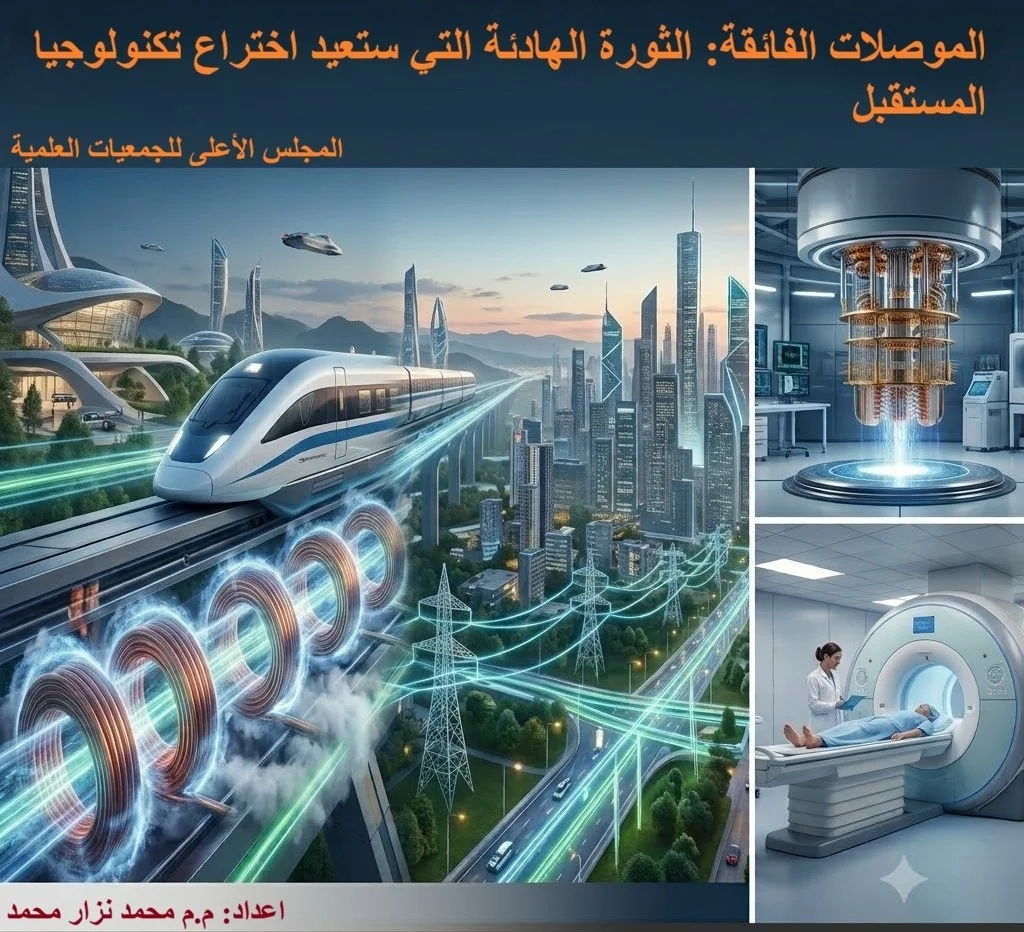
Superconductors: the quiet revolution that will reinvent the technology of the future.
By: Assistant Lecturer (M.M Mohammed Nizar Mohammed)
Workplace: General Directorate of Education in Salah al-Din / Al-Duluiyah Education Department.
In collaboration with:
Supreme Council of Scientific Associations
Materials in nature are classified based on their electrical conductivity into: conductors, semiconductors, and insulators. However, scientists have succeeded in developing a unique fourth category called superconductors, which have sparked a real revolution in the world of technology.
1- What is the phenomenon of superconductivity
Today, this phenomenon is considered one of the most important discoveries in solid-state physics. Some metals and chemical compounds are characterized by their electrical resistivity completely vanishing when cooled to a specific low temperature. In other words, electric current flows within these materials without any loss or dissipation of energy, granting them exceptional and unlimited conductivity.
2- Discovery and defining the "critical temperature"
The credit for discovering this phenomenon goes to the Dutch physicist Heike Kamerlingh Onnes in 1911. While studying the electrical conductivity properties of pure mercury, he noticed that its resistance suddenly disappeared and became zero when cooled using liquid helium to a temperature of 4.2 Kelvin (equivalent to -286 degrees Celsius). The temperature at which a material loses its resistance to become a superconductor was named the critical temperature and is denoted by the symbol (Tc).
3- Scientists' race towards "room temperature"
Before this discovery, the prevailing belief was that materials only become superconductive at absolute zero (-273 degrees Celsius). But after Onnes' experiment, a scientific race began to find materials with higher critical temperatures:
- Early 1940s: A critical temperature of 15 Kelvin was achieved.
- 1973: The temperature rose to 23 Kelvin.
- 1986: Researchers succeeded in reaching 30 Kelvin by manufacturing special ceramic materials.
Research has continued globally to develop what are known as "high-temperature superconductors," which approach standard room temperature more closely.
4- Exceptional magnetic properties
In addition to zero resistance, these materials possess an astonishing property upon reaching the transition temperature: they completely expel and repel any external magnetic field, regardless of its intensity. These captivating properties have opened doors for innovation, utilizing them as a powerful alternative to semiconductors in precision industries such as transistors, solar cells, and integrated circuits.
5- Revolution in electrical power transmission
This technology offers a radical and cost-effective solution for power transmission. Traditional copper networks cost enormous sums and waste significant energy as dissipated heat due to wire resistance. To illustrate the vast difference in efficiency:
- Traditional copper wire: Carries a current of 100 amperes per square centimeter.
- Superconducting YBa2Cu3O7 compound wire: Can carry a current of 100,000 amperes per square centimeter!
6- High-speed maglev trains
Superconductors have made a strong entry into modern transportation, specifically in manufacturing high-speed maglev trains. Thanks to the system of superconducting materials inside the train, it levitates above the railway track, moving without any direct friction. This method enables tremendous speeds of up to 500 km/h, while saving massive amounts of energy and completely eliminating noise and bumps to ensure very comfortable long-distance journeys.
7- Wide industrial and medical applications
There are numerous other vital uses for these materials to serve humanity in various fields, most notably:
- Electronics: Manufacturing ultra-small computers with high efficiency and speed.
- Energy storage: Creating giant coils to store energy for a certain period without loss.
- Medicine: Producing extremely powerful electromagnets for Magnetic Resonance Imaging (MRI) devices, which are indispensable for diagnosing critical diseases.
- Communications: Developing digital electrical circuits and microwave filters in cellular phone transmission stations.
- Geology and oil: Using advanced detectors (SQUID detectors) to capture subtle signals that conventional devices are unable to sense.
Conclusion: The applications of these materials cannot be confined to a single article, but in any case, they promise a tremendous leap in technological development, especially if invested correctly and skillfully.
Source:
Kittel, C. (2021). Introduction to solid state physics Eighth edition.