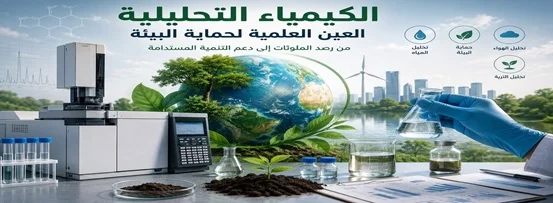
Analytical chemistry... the scientific eye for environmental protection and achieving sustainable development.
Prepared by: M.M. Hala Saad Ahmed Al-Samarrai / Assistant Lecturer – Chemistry Specialization
Ministry of Education / General Directorate of Education in Salah al-Din / Tikrit High School for Distinguished Students
Email: [email protected]
Introduction
The environment in the modern era is witnessing increasing challenges due to industrial and agricultural growth and urban expansion, leading to the emergence of new pollutants that affect the quality of water, air, and soil, posing a risk to human health and living organisms. In facing these challenges, analytical chemistry has emerged as one of the most important branches of chemistry, due to its means and techniques capable of detecting pollutants and determining their concentrations with high accuracy, making it a fundamental pillar in environmental protection and supporting sustainable development.
1- Analytical Chemistry and Its Role in Environmental Monitoring
Modern environmental monitoring programs rely on analytical chemistry to assess the quality of various environmental elements, as it contributes to analyzing water, soil, and air samples and detecting chemical and biological pollutants before they reach levels that pose a risk to humans or the ecosystem .Analytical chemistry is distinguished by its ability to measure extremely small concentrations of chemicals, which helps relevant authorities take appropriate preventive measures and limit the spread of pollution.
2- Modern Techniques in Pollutant Detection
Recent decades have witnessed significant development in analytical instruments, as laboratories now rely on advanced techniques such as: Gas Chromatography-Mass Spectrometry (GC-MS).
Liquid Chromatography-Tandem Mass Spectrometry (LC-MS/MS).
Inductively Coupled Plasma Mass Spectrometry (ICP-MS).
Fourier Transform Infrared Spectroscopy (FTIR).
Atomic Absorption Spectroscopy (AAS).
These techniques have contributed to detecting heavy metals, pesticide residues, toxic organic compounds, pharmaceutical pollutants, and microplastics (Microplastics), even at very low concentrations, thereby enhancing the accuracy of environmental risk assessment.
3- Supporting Sustainable Development
The role of analytical chemistry is not limited to diagnosing pollution, but extends to supporting sustainable development by providing accurate scientific data that helps decision-makers formulate environmental policies, evaluate the efficiency of water treatment plants, monitor food quality, and reduce industrial pollution .The results of chemical analyses also contribute to protecting natural resources and rationalizing their use, which aligns with the sustainable development goals aimed at providing a healthy and safe environment for current and future generations.
4- Green Analytical Chemistry
Green analytical chemistry has become one of the modern scientific trends aimed at developing analytical methods that reduce the use of hazardous solvents and chemicals, lower energy consumption and waste production, while maintaining the accuracy of results and analysis efficiency. This approach represents an important step towards making laboratories safer and more environmentally friendly, achieving a balance between scientific development and the conservation of natural resources.
5- The Future of Analytical Chemistry
The world is currently moving towards integrating artificial intelligence and Internet of Things technologies with analytical instruments, allowing for faster and more accurate analysis of environmental data and predicting pollution sources before they worsen, thereby enhancing the efficiency of environmental monitoring systems and early response to risks. These developments are expected to expand the role of analytical chemistry in the fields of environmental monitoring, food safety, public health, and natural resource management.Conclusion
Analytical chemistry today represents the cornerstone of efforts to protect the environment. It is the science that enables researchers to see what is invisible to the naked eye and to detect pollutants before they turn into environmental and health crises. As analytical techniques advance, our ability to protect humans and the environment, support sustainable development, and build a safer and cleaner future increases.Environmental protection does not begin with removing pollution, but with detecting it accurately, and here lies the mission of analytical chemistry in serving humanity and the environment.”
1- Richardson, S. D., & Kimura, S. Y. (2023). Emerging environmental contaminants: Challenges and perspectives. Analytical Chemistry.
2- Cairns, W. R. L., Butler, O. T., et al. (2024). Atomic spectrometry update. Journal of Analytical Atomic Spectrometry.